

Prayer and Gratitude in a Mechanical Universe
Unless the Lord builds the house,
They labor in vain who build it;
Unless the Lord guards the city,
The watchman stays awake in vain.
Psalm 127:1
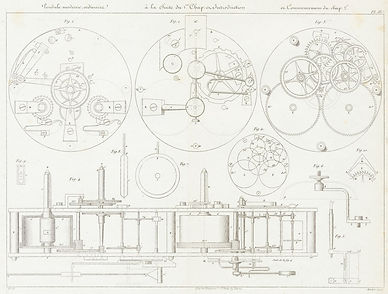
What gets called the Age of Enlightenment was a period of drastic change informed by new scientific discoveries and philosophical ideas. It was in this period that Isaac Newton articulated his laws of motion, giving us the means to articulate the motion of objects in mathematical terms. That, in turn, provided us with all sorts of predictive power over objects around us. It was as if a veil was lifted, and we could now witness the universe running like clockwork.
As marvelous as these discoveries are, Newtonian mechanics present us with a theological problem: if the motion of all things really is that predictable–if the universe truly runs with clockwork precision–what could we say God is doing, really, except perhaps winding up the clock? And what, therefore, would be the point of petitioning him in prayer? It’s no coincidence that the Enlightenment was a time in which many intellectuals began to consider themselves deists, a position which conceded that God was indeed necessary to set the world in motion, but he was not the kind of God who intervened in the affairs of the world. While we don’t have many self-proclaimed deists these days, the effects of this perspective linger. The apparent futility of “thoughts and prayers” is expressed by all sorts of people in the wake of any major disaster. What can prayers do for a course of events that has already been set in motion?

The Newtonian mechanical perspective, however, is merely that: a perspective. It is a way of understanding the world, but is not the way of understanding the world. We need not make this view an absolute one. Even as a matter of science, Newtonian mechanics no longer have the power to explain the cosmos as people once thought they did: relativity theory and quantum mechanics present us with a universe that is a bit more surprising and mysterious. God, being a God of order, has indeed created an ordered world, one in which we can perceive how to act in, and which often yields reliable consequences we can understand. And yet that hardly means that everything is perfectly predictable. Historically, it has often been true that when two armies fight, the bigger one wins. And yet it is also true that tables turn, vibes shift, and what seemed so solid and immovable begins to fall apart. For our sanity’s sake, we make retrospective attempts to make sense of these unexpected happenings. Perhaps that’s partly to restore our faith in the mechanical universe in which things are a bit simpler and easy to understand. But the explanations are not always satisfying.
We may accept intellectually that the world does not run mechanically, and yet there are times when we think we’ve got some aspect of this world figured out. We may believe we have mastered the mechanics of generating wealth, for instance, or of looking beautiful or being successful in some way that convinces us that we don’t need any help from the outside. We may temporarily come to believe that we are the generators of our own success. All of that supposes a level of independence and self-actualization that we really don’t have. Consider an example: After their years of wandering, the people of Israel entered the promised land, and we learn God’s provision of manna finally ends: “Now the children of Israel camped in Gilgal, and kept the Passover on the fourteenth day of the month at twilight on the plains of Jericho. And they ate of the produce of the land on the day after the Passover, unleavened bread and parched grain, on the very same day. Then the manna ceased on the day after they had eaten the produce of the land; and the children of Israel no longer had manna, but they ate the food of the land of Canaan that year.” (Joshua 5:10-12)

What we see in this passage is an instance of God changing the means by which he provides for his people. Once, while they wandered, he fed them directly. Now, as they enter the land of promise, they are now able to participate in that provision. And yet, God is still the chief actor. God is not just one of many agents acting upon the world; he is the principal one. The world has regularity because God sustains it continually at each moment, not because it is mechanical. I think the quickest way to gratitude is to understand that we are not the primary cause of our successes. We may have each worked hard to achieve things, but that working requires a whole lot of prerequisites: our continued existence, the ability to breathe, walk, see, understand, a stable economy, a certain degree of civilizational trust, and probably a lot of effort and investment in us from other people. These are just our surface-level needs! There is so much required to keep us going that we are simply not capable of comprehending it all the time, and that leaves room for a lot of gratitude each day.
Gratitude would be enough for us to come to the Father in prayer, but as the Church, we have another role. God created Adam to be a priest, which is another way of saying a mediator. It was his role to represent God to his creation, and represent the creation before God. This is a role that the church continues: “you are a chosen people, a royal priesthood, a holy nation, God’s special possession, that you may declare the praises of him who called you out of darkness into his wonderful light.” (1 Peter 2:9) For the church to fail to pray continuously is to refuse the role God intended for us in interceding for the rest of the world. We intervene in the lives of others to the extent that our limitations allow, but we must soon recognize our limits and rely on him in prayer thereafter, recognizing that God is God, and we are not. Through our own actions, and through prayer, God is inviting us to participate in his own work in this world. Things are not so mechanical as they sometimes appear, and God is asking us to trust that that is so.


Comments