

A More Perfect Union

“Now the Lord is the Spirit; and where the Spirit of the Lord is, there is liberty.”
-2 Conirnthians 3:16-18
The United States of America is 250 years old today. Happy Independence Day! As Americans, we have much to be thankful for in the freedoms we have. Not least of those is the freedom to worship God without persecution. That is something, even in the world today, that is not guaranteed. Presidents of widely ranging levels of quality come and go, and so far that freedom has remained protected. Liberty is something to celebrate, and is celebrated in the Bible, no less. Our Lord identified his coming with this prophecy in Isaiah chapter 61:
“The Spirit of the Lord is upon Me,
Because He has anointed Me
To preach the gospel to the poor;
He has sent Me to heal the brokenhearted,
To proclaim liberty to the captives
And recovery of sight to the blind,
To set at liberty those who are oppressed;
To proclaim the acceptable year of the Lord.”
The coming of Christ is the Jubilee of Jubilees, the restoration of all things and all people to their inheritance as children of God, and the liberty of all captives and slaves. It is the promise of being under Christ’s lordship and yet also perfectly free–and perfectly free, I would add, because we are under his lordship. I’m sure that might sound paradoxical or even simply contradictory to folks who aren’t Christians, but liberty can be a nebulous term, and people mean different things when they say it. What I believe it has come to mean for many Americans is perfect autonomy and freedom from all personal constraints; it means freedom from people if we think that they are in some way constraining us. The product of that way of thinking is things like talk of needing to get “toxic” people out of one’s life, or the trend of adult children going “no-contact” with their parents over seemingly irreconcilable differences.
Allow me to acknowledge the fact that, due to human failing, there must at times be separation between individual people or larger people groups. The severing of human bonds is not good, but sometimes necessary for the protection of vulnerable people or for any future reconciliation to be possible. And yet, reunion and reconciliation must be the ultimate aim. The reality of things is that there is no such thing as a human individual. That is, it is impossible for us to have any sort of life independent from other people. We did not will ourselves into existence. The very language we use to think and reason in our own minds is an inheritance we receive from others. We cannot be human without other humans, and to continually choose to isolate ourselves from them when it gets difficult to be around them will prove to make us less human.
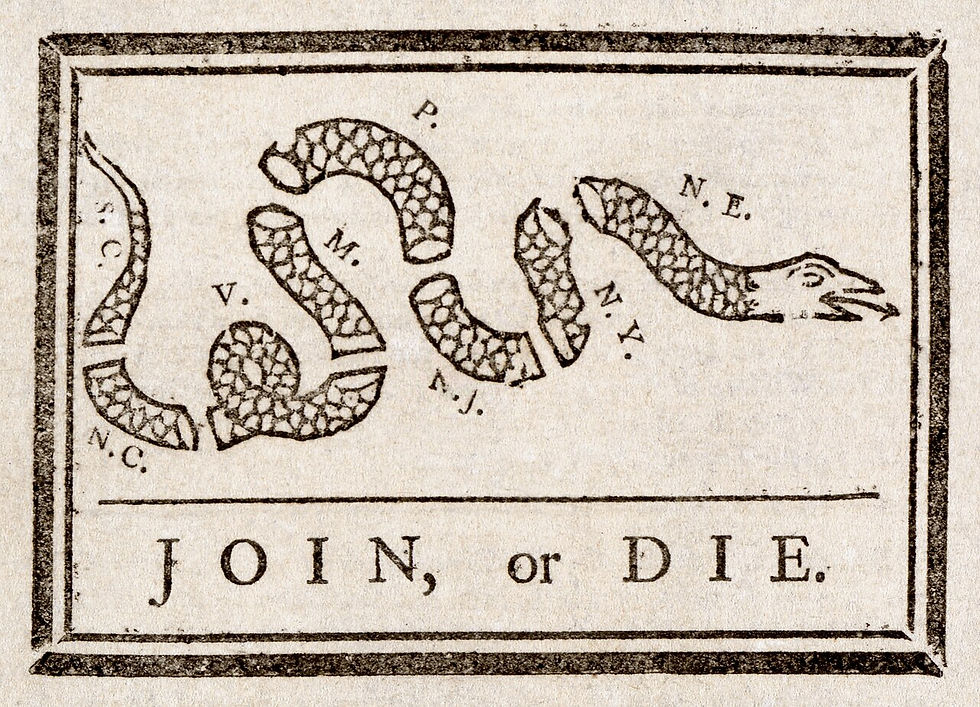
I hold this truth to be self-evident: that God delights in using intermediaries to give his gifts to us. When we cut ourselves off from other people, we are necessarily cutting ourselves off from what God has to offer us through them. That thought should make us shudder. What true liberty requires, it seems to me, is a declaration of dependence upon one another. I’m not sure that America’s founding fathers would even disagree. What did the founders hope to achieve with the ratification of the American Constitution? We need look no further than its preamble: “to form a more perfect Union, establish Justice, insure domestic Tranquility, provide for the common defence, promote the general Welfare, and secure the Blessings of Liberty to ourselves and our Posterity”. The aim of the founding fathers, whatever their failures in securing it might have been, was justice, peace, liberty, and the welfare of all people. This was hardly a libertine project. It’s almost as if they were operating under the assumption that it’s not possible to fully secure those things unless they’re secured for everyone.
As much as I love America my home, I believe that a more perfect union is better secured in the Kingdom of God, in communion with Christ and his people. There the principal law is love, and its king embodies that law better than anyone. G.K. Chesterton once wrote, “Love is not blind; that is the last thing that it is. Love is bound; and the more it is bound the less it is blind.” It is not autonomy which frees us, but (very counterintuitively to us) our submission. In 1 Peter 2:15-17 we read, “for this is the will of God, that by doing good you may put to silence the ignorance of foolish men—as free, yet not using liberty as a cloak for vice, but as bondservants of God. Honor all people. Love the brotherhood. Fear God. Honor the king.” And God save us from the hell of a total independence.


Comments